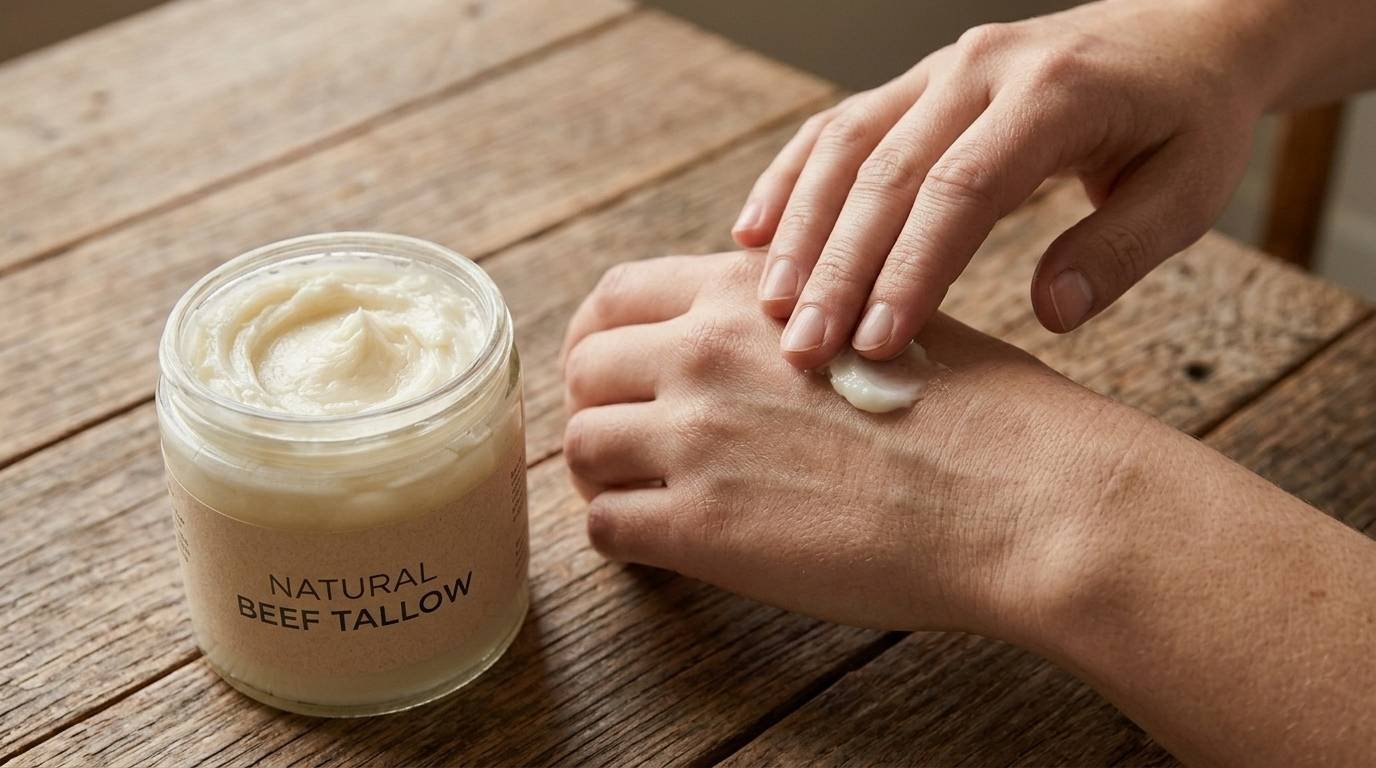

Scroll through TikTok or Instagram for five minutes and you will probably see someone smoothing a creamy white balm onto their face and calling it “ancestral skincare.” That balm is beef tallow, and beef tallow for skin has gone from a kitchen-and-candle ingredient to one of the most debated trends in natural skincare.
So is it a forgotten miracle moisturizer or just viral marketing? The honest answer sits in the middle. Tallow can soften dry skin, but the evidence for the big claims is thin, and dermatologists raise some real concerns. This guide walks you through what tallow is, what the research actually shows, who might do well with it, who should skip it, and how to test it without wrecking your skin barrier.
Quick Answer: Is Beef Tallow Good for Skin?
Beef tallow can work as a basic, heavy moisturizer for dry skin, but there is no strong clinical evidence that it does more than other moisturizers, and it carries a real risk of clogged pores, irritation, and inconsistent quality. Major dermatology sources currently do not recommend it over standard, fragrance-free moisturizers.
Key takeaways:
- Tallow is rendered cow fat, mostly made of oleic, palmitic, and stearic fatty acids.
- It acts as an occlusive: it sits on skin and slows water loss.
- Human research is limited. A 2024 review found only 19 relevant studies, and none was a large trial of tallow as a modern face product.
- It has no sun protection, can be comedogenic for acne-prone skin, and is not regulated as a skincare ingredient.
- If you try it, patch test first, use a tiny amount, and keep wearing sunscreen.
What Is Beef Tallow?
Beef tallow is rendered beef fat. It usually comes from suet, the firm fat that surrounds a cow’s kidneys and loins. The fat is melted down, strained to remove solids and water, and cooled into a solid, creamy substance that looks a bit like shortening.
People have used it for centuries in cooking, candle making, and soap. Today it is sold in skincare as “tallow balm,” “whipped tallow,” and “tallow moisturizer,” sometimes blended with olive oil, jojoba oil, or essential oils.
Why it is trending now: Interest in “clean,” short-ingredient-list products, distrust of long chemical-sounding labels, and a wave of influencer testimonials have all pushed tallow into the spotlight. Dermatologists point out that “natural” and “chemical-free” are marketing words, not safety guarantees, and that tallow itself is a chemical mixture of fats like any other ingredient.
What Is Actually in Beef Tallow?
Tallow is mostly triglycerides, which are fats built from fatty acids. The main ones are:
- Oleic acid: a softening fatty acid, also found in olive oil and in your skin’s own oils.
- Palmitic acid: a saturated fat that helps form a protective feel on skin.
- Stearic acid: a firm, waxy fatty acid often used in creams and balms.
Tallow also contains small amounts of fat-soluble vitamins, including A, D, E, and K, plus B12 according to Cleveland Clinic. The key word is small. Cleveland Clinic’s dermatology resident notes there is not enough research on how well these vitamins absorb through skin or whether they give meaningful benefits, and that pure or unregulated tallow likely does not contain enough vitamin A to act like retinol.
The nutrient content also varies with the animal’s diet, how the fat was rendered, and how it was stored, so two jars labeled “tallow” can behave very differently.
The “Tallow Is Like Your Skin’s Natural Oil” Claim
The most common selling point is that tallow resembles human sebum, your skin’s natural oil, so it “fits” your skin. There is a kernel of truth: oleic, palmitic, and stearic acids are fatty acids found in human skin lipids too.
But it is an oversimplification. Your skin barrier relies on a specific mix of lipids, including ceramides, cholesterol, and free fatty acids, and sebum contains components like squalene and wax esters. Tallow is mostly triglycerides and does not replicate that structure. “Similar ingredients” is not the same as “proven to repair the barrier,” and nobody has shown tallow outperforms ceramide-based moisturizers.
What Does the Research Say About Beef Tallow for Skin?
This is where hype and evidence part ways.
The most cited source is a 2024 scoping review of tallow and its biocompatibility with skin published in the journal Cureus. The authors screened 147 studies and kept 19 that fit their criteria, a mix of comparative, basic science, and animal studies. Their conclusion: there are significant research gaps in how tallow can be used on human skin, and more research is needed, especially on tallow as a cosmetic product in people.
In plain English:
- Plausible: Tallow’s fatty acids may help dry skin hold moisture.
- Not proven: Claims that it cures eczema, psoriasis, acne, or wrinkles.
- Missing: Large, well-designed human trials of modern tallow skincare.
Some small studies have tested tallow-based preparations on dry skin, atopic dermatitis, and psoriasis, and some websites highlight those results. Be careful with them: many used blended formulas (not plain tallow), had small participant numbers, and cannot be applied to a jar of whipped tallow you buy online.
Cleveland Clinic also notes that research has found many social media claims about tallow’s benefits were made with a financial motive in mind. That does not mean everyone praising tallow is lying, but it is a good reason to treat testimonials as stories, not evidence.
Potential Benefits of Beef Tallow for Skin
Based on what is reasonable to say today, here is what tallow may realistically offer:
- Occlusive moisture. Like petroleum jelly, shea butter, or coconut oil, tallow can form a layer that slows water loss. This is the main, believable benefit for dry, rough areas such as heels, elbows, and hands.
- A simple ingredient list. If you prefer products with very few ingredients, a plain tallow balm is simple. Simple does not automatically mean safer, but it does make it easier to spot what you react to.
- Softening feel. Tallow melts at skin temperature, which many people find pleasant on dry patches and lips.
- A byproduct with a use. Tallow comes from the meat industry’s leftover fat, which some people see as less wasteful than petroleum-based balms. (It is not vegan or vegetarian, and it still raises animal-agriculture questions.)
What tallow does not do: it does not protect from UV, it does not replace retinoids or prescription treatments, and it has not been shown to treat acne, eczema, or psoriasis.
Risks and Side Effects of Beef Tallow on Your Face
Dermatology sources agree on several concerns.
1. Clogged pores and breakouts
The American Academy of Dermatology guidance summarized by Franklin Dermatology describes tallow as comedogenic, meaning it can clog pores and trigger acne, especially in oily or acne-prone skin. Cleveland Clinic says its thick consistency can keep natural oils from surfacing easily and lead to more breakouts.
2. Irritation and trapped heat
Heavy balms can trap heat and may worsen sensitive-skin conditions like rosacea. Many tallow products also add fragrance or essential oils to cover the natural smell, and those added ingredients can irritate.
3. Allergic reactions
You can react to a new product even if you are not allergic to beef. Added oils, fragrances, and processing residues are common culprits.
4. No sun protection
Tallow has no SPF. Cleveland Clinic notes that as a thick oil, it may even increase sensitivity to sunburn. The AAD recommends a moisturizer or sunscreen of SPF 30 or higher on exposed skin outdoors.
5. Quality, contamination, and rancidity
The FDA regulates beef tallow as a food, not as a skincare ingredient, so there is no standard for sourcing, purity, or preservatives in skincare tallow. Improperly processed or stored tallow can pick up bacteria or other microorganisms, which may lead to skin infections. Pure tallow also has no preservatives, so it can spoil or go rancid faster than formulated moisturizers.
6. Smell
Well-made tallow has a mild scent, but a strong meaty smell is common in lower-quality or rushed batches.
Who Might Try It, and Who Should Skip It
May be worth a careful patch test:
- Adults with normal-to-dry skin looking for a thick balm for body areas
- People who want a simple occlusive for cracked heels, elbows, or chapped lips
- Anyone whose usual products are fragrance-free but not heavy enough in winter
Better to skip, or talk to a dermatologist first:
- Acne-prone or oily skin
- Rosacea or very reactive skin
- Anyone with active eczema flares, open cracks, or broken skin (infection risk)
- People using prescription topicals or retinoids who want to layer it on
- Anyone who avoids animal products
- Babies and young children, unless a pediatrician okays it
How to Patch Test Beef Tallow Before Using It
A patch test is the single most useful thing you can do.
- Choose a small spot, such as the inside of your forearm or along your jaw.
- Apply a rice-grain amount once a day for 3 to 5 days.
- Watch for redness, itching, bumps, or tiny whiteheads.
- If anything shows up, stop and do not use it on your face.
- If the skin looks calm, try a thin layer on a small part of your face at night for a week before expanding.
Change one product at a time. If you introduce tallow while also trying a new cleanser and serum, you will not know which one caused a reaction.
How to Use Beef Tallow on Your Skin (If You Decide to Try It)
- Start with clean, slightly damp skin. Moisture underneath helps the balm seal it in.
- Use a pea-sized amount. More is not better. Thick layers are what most often cause breakouts.
- Warm it between your fingertips. Then press it in rather than rubbing hard.
- Use it at night first. That way you can see how your skin responds, and you avoid a shiny, heavy look under makeup.
- Keep your sunscreen. Apply SPF 30 or higher in the morning. Tallow is not a replacement.
- Keep it away from active treatments. Do not stack it over retinoids, exfoliating acids, or prescription creams unless your dermatologist agrees.
- Stop if skin worsens. New breakouts, itching, or burning mean it is not for you.
Good spots to start: heels, elbows, knees, hands, and lips, which tolerate heavy balms better than the face.
How to Choose a Beef Tallow Product
If you buy tallow skincare, quality matters more than the label.
- Short ingredient list. Look for tallow plus a small number of simple oils. Avoid added fragrance.
- Transparent sourcing. The brand should tell you where the fat comes from and how it was rendered. Grass-fed and pasture-raised sourcing is a common standard, but certifications and farm information tell you more than the words alone.
- Fresh and properly stored. Check for a made-on or best-by date, a clean smell, and a sealed jar. Some brands suggest storing in a cool, dry place and extending life in the fridge, but follow the maker’s storage instructions.
- Skip DIY if you can. Homemade tallow has the same unregulated-quality problems, plus the risk of bacteria if it is not processed and stored carefully.
- Discard it if it smells sharp, sour, or paint-like. That points to rancidity.
Beef Tallow vs. Other Moisturizers
| Option | Best for | Main trade-off |
|---|---|---|
| Beef tallow | Dry, rough body areas; people wanting a simple balm | Can clog pores, no SPF, no quality standard, not vegan |
| Ceramide cream (for example CeraVe, Cetaphil, Vanicream) | Everyday face and body, sensitive or eczema-prone skin | Less “natural” marketing, but consistent and tested |
| Petroleum jelly | Cracked skin, sealing in moisture, lips | Greasy feel; petroleum-derived |
| Shea butter | Dry body skin, vegan-friendly | Can still feel heavy on the face |
| Squalane | Lightweight facial moisture | Not as rich for very dry skin |
| Hyaluronic acid serum + cream | Dehydrated, normal, or oily skin | Needs a cream on top to seal it in |
Cleveland Clinic recommends fragrance-free moisturizers that combine humectants (draw water in), emollients (smooth the skin), and occlusives (seal moisture in). The AAD guidance cited by Franklin Dermatology points to brands such as CeraVe, Cetaphil, and Vanicream as gentle options free of common allergens.
Common Mistakes to Avoid
- Using too much. A thick layer is the fastest route to clogged pores.
- Skipping sunscreen. Tallow does not protect against UV.
- Treating it as acne or eczema treatment. It is not a medical treatment.
- Buying on hype. A viral jar is not the same as a quality-tested product.
- Layering it over strong actives. It can interfere with absorption or increase irritation.
- Ignoring early warning signs. Tiny bumps and tightness around the jaw are often the first sign it is too heavy for your skin.
Frequently Asked Questions
Is beef tallow good for your skin?
It can moisturize and soften dry skin as an occlusive, but there is not enough research to say it is better than other moisturizers, and dermatology sources currently do not recommend it over standard fragrance-free options.
Is beef tallow good for your face?
It depends on your skin. Dry, non-acne-prone skin may tolerate a thin layer, but oily or acne-prone skin has a higher chance of clogged pores and breakouts. Patch test first.
Can beef tallow cause acne?
Yes, it can. It is described as comedogenic by dermatology guidance, particularly for oily and acne-prone skin, and using too much increases the risk.
Does beef tallow have vitamins that help skin?
It contains small amounts of fat-soluble vitamins (A, D, E, K, and B12 per Cleveland Clinic), but there is not enough evidence that they absorb or help skin in meaningful ways, and the amounts do not match retinol or targeted vitamin products.
Does beef tallow protect from the sun?
No. It has no SPF and may increase sunburn risk. Use sunscreen of SPF 30 or higher.
Does beef tallow help eczema or psoriasis?
There is no solid clinical proof. Some small studies explored tallow-based preparations, but the research is limited. If you have eczema or psoriasis, ask a dermatologist before using it, especially on cracked or broken skin.
Does beef tallow smell?
Well-rendered tallow has a mild smell. Strong meaty or sour odors suggest low-quality fat or rancidity, and fragranced products may hide the smell but can add irritation risk.
How long does tallow balm last?
It depends on the product and storage. Pure tallow has no preservatives and can go rancid faster than formulated moisturizers, so follow the label, store it cool and dry, and throw it out if the smell changes.
Is homemade beef tallow safe for skin?
It carries the same unregulated-quality risks as store-bought tallow, plus a higher chance of contamination if the fat is not processed, strained, and stored carefully. Many dermatologists would suggest skipping DIY.
What can I use instead of beef tallow?
Fragrance-free ceramide moisturizers, petroleum jelly, shea butter, squalane, and hyaluronic acid with a cream on top all offer well-understood hydration. Your dermatologist can help match one to your skin type.
When to See a Dermatologist
Book a visit if you have persistent dryness that does not improve with over-the-counter moisturizers, itchy, scaly, or cracked patches that may be eczema or psoriasis, recurring breakouts, or any reaction (swelling, hives, spreading redness) after using tallow. Stop using the product first, and seek urgent care for serious allergic symptoms like facial swelling or trouble breathing.
Final Verdict: Should You Use Beef Tallow for Skin?
Beef tallow is a heavy, old-fashioned balm that can feel nice on dry, rough areas. That is about as far as the evidence goes. The big promises of healing eczema, erasing wrinkles, or clearing acne are not backed by solid human trials, and the risks, from clogged pores to inconsistent quality, are real.
If you are curious, treat it like a low-stakes experiment: pick a reputable product with a short ingredient list, patch test, use a tiny amount on body areas first, keep your sunscreen, and stop if your skin objects. And if you want proven hydration with fewer unknowns, a fragrance-free ceramide moisturizer is still the safer bet.
Medical disclaimer: This article is for general education and is not medical advice. Talk to a qualified dermatologist or healthcare provider before changing your skincare routine, especially if you have a skin condition.
Sources referenced: Cleveland Clinic Health Essentials (dermatology resident Angela Wei, MD), Franklin Dermatology summary of American Academy of Dermatology guidance, and the 2024 Cureus scoping review “Tallow, Rendered Animal Fat, and Its Biocompatibility With Skin.”