
You reach for something on a high shelf, or you cough hard during a cold, and suddenly there is a sharp, catching pain between two ribs. Now every deep breath hurts, and so does rolling over in bed. That pattern is the classic sign of an intercostal muscle strain, a pulled muscle between the ribs.
It is one of the most common causes of chest wall pain, and it is also one of the most frustrating, because you cannot rest a muscle you use 20,000 times a day just to breathe. The good news: it is rarely dangerous, and most people recover fully with simple care. The key is knowing what it is, what it is not, and how to protect your breathing while it heals.
Quick Answer: What Is an Intercostal Muscle Strain?
An intercostal muscle strain is a stretch or partial tear in the small muscles that sit between your ribs. It causes localized, sharp or catching pain that gets worse when you breathe in deeply, cough, sneeze, twist, or reach. Mild strains often settle in 2 to 3 weeks, while moderate ones can take 6 weeks or longer. Chest pain with shortness of breath, or rib pain after a hard impact, needs medical evaluation first.
Key Takeaways
- The intercostal muscles link your ribs and help you breathe, so a strain hurts with every breath.
- Twisting, overhead reaching, heavy coughing, and sports like golf, rowing, and tennis are the usual triggers.
- You can often press on one exact spot between two ribs and reproduce the pain.
- Keep breathing deeply and gently, even though it hurts. Shallow breathing for days raises the risk of chest infection.
- Heart, lung, and rib fracture problems can look similar, so know the red flags before you self-treat.
What Are the Intercostal Muscles?
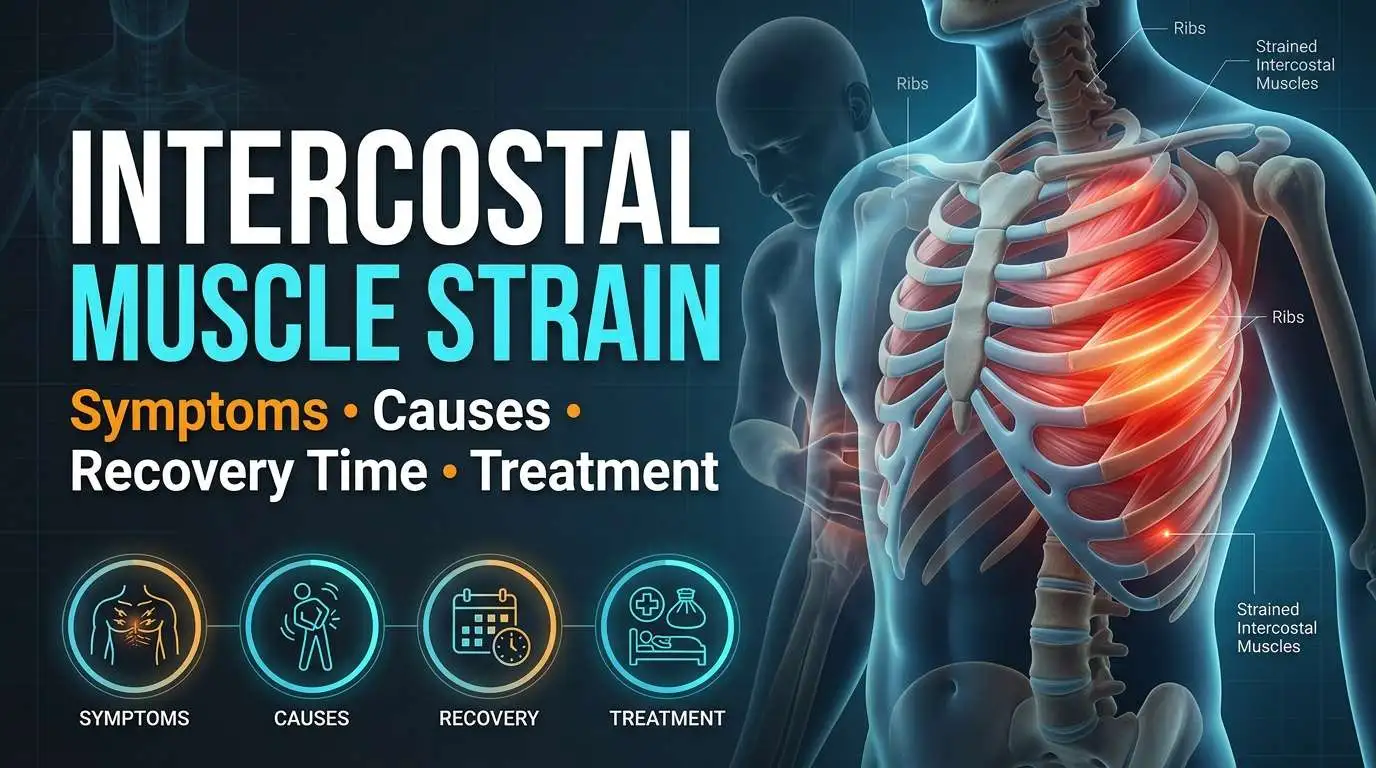
Your intercostal muscles fill the 11 gaps between your 12 ribs. There are three layers:
- External intercostals: the outer layer, mainly active when you breathe in.
- Internal intercostals: the middle layer, mainly active when you breathe out forcefully.
- Innermost intercostals: the deepest layer, which assists the internal layer.
Together they lift and lower the rib cage, stiffen the chest wall, and help you twist and bend the trunk. Think of them as the guy-wires of a tent: they hold the frame steady while it moves. When one section is injured, the whole system has to keep working anyway, which is why this injury lingers.
Intercostal Muscle Strain Symptoms
Symptoms depend on how much of the muscle is injured, but most people notice:
- Sharp, stabbing, or catching pain between two ribs, on the side, front, or back of the rib cage
- Pain that spikes with deep breaths, coughing, sneezing, laughing, or yawning
- A tender spot you can pinpoint with one finger
- Pain with twisting, side bending, or reaching overhead
- Muscle tightness or spasm along the ribs
- Shallow breathing, because deep breaths hurt
- Difficulty finding a sleeping position, especially lying on the injured side
- Mild swelling or bruising in more significant strains
A mild strain may feel like a dull ache or stiffness. A more serious one can cause pain with even small movements, and the pain may build over several hours after the injury rather than all at once.
What Causes an Intercostal Muscle Strain?
These muscles rarely strain during easy daily activity. Most cases follow a sudden load, a twist, or repeated stress, especially when the muscles are tired or out of shape.
Common causes
- Forceful coughing or sneezing. A long bout of bronchitis, allergies, or a bad cold can overload the muscles through sheer repetition.
- Twisting while lifting. Hoisting a bag, a child, or a box while rotating your torso is a classic trigger.
- Overhead reaching. Painting a ceiling, hanging holiday lights, or stocking high shelves.
- Rotational sports. Golf, tennis, baseball, rowing, swimming, and martial arts.
- Direct impact. Falls, sports collisions, or car accidents.
- Intense workouts after time off. A sudden jump in training volume, especially with rows, pull-ups, or heavy overhead presses.
- Postpartum and new-parent strain. Repetitive lifting and carrying with a weakened core.
Risk factors
- Poor conditioning or a sudden increase in activity
- Skipping warm-ups
- Physically demanding work with repeated twisting or overhead tasks
- Contact sports
- A lingering cough from a respiratory illness
Is It an Intercostal Strain or Something Else?
This is the question most articles skip, and it is the one that matters most. Chest and rib pain has many causes, and a few are urgent. Use this table as a starting guide, not a diagnosis.
| Condition | What it tends to feel like | Clues that point to it |
|---|---|---|
| Intercostal strain | Sharp, localized pain between ribs | Followed a twist, reach, cough, or sport; tender spot; worse with movement and breathing |
| Costochondritis | Aching or sharp pain at the front, beside the breastbone | Tenderness where ribs meet cartilage; often no clear injury |
| Rib fracture | Severe, pinpoint pain, often with a sharp catch on breathing | Followed a fall or blow; very tender over the bone; sometimes a crunching feeling |
| Heart-related pain | Pressure, tightness, or heaviness; may spread to arm, jaw, or back | Sweating, nausea, shortness of breath; not reproduced by pressing or moving |
| Pleurisy or pneumonia | Sharp pain with breathing, often with fever or cough | Fever, chills, or colored mucus; hard to pinpoint |
| Shingles | Burning or band-like pain on one side | A rash or blisters usually appears within days |
| Intercostal neuralgia | Burning, electric, or shooting pain along a rib | Nerve-type pain; may follow shingles or surgery |
One handy clue: pain from a strained muscle usually changes when you move, press on it, or take a breath. Pain from the heart usually does not.
When to See a Doctor (or Call 911)
Call 911 or go to the emergency room right away if you have:
- Chest pain or pressure with shortness of breath, sweating, nausea, or pain spreading to your arm, jaw, or back
- Sudden sharp chest pain with trouble breathing
- Severe difficulty breathing, blue lips, or coughing up blood
- Chest pain after a major impact such as a car accident or hard fall
Book a visit with your doctor if:
- The pain is severe or you cannot take a comfortable breath
- It has not improved after a week or two
- You have a fever, chills, or yellow or green mucus
- You develop a rash or blisters along the ribs
- You are on blood thinners and had any impact to the chest
- You are not sure what is causing the pain
When in doubt with chest pain, get it checked. It is much better to be told it is just a muscle than to guess wrong.
How Is an Intercostal Muscle Strain Diagnosed?
Most cases are diagnosed in the office from your story and a physical exam. Your clinician will ask what you were doing when the pain started, then press along the ribs, check how the chest expands, and watch how you twist and bend. They will also listen to your lungs.
Imaging is not needed to confirm a strain. A chest X-ray, ultrasound, or MRI is mainly used to rule out a rib fracture, a lung problem, or another injury, especially after trauma or if your symptoms do not fit.
Strain Grades
| Grade | What happens | Typical recovery |
|---|---|---|
| Grade 1 (mild) | A small number of fibers are overstretched or torn | Days to about 3 weeks |
| Grade 2 (moderate) | A larger partial tear with noticeable loss of movement | Roughly 3 to 8 weeks |
| Grade 3 (severe) | A complete tear, which is uncommon | Longer; may need specialist care |
These are typical ranges, not promises. Age, activity level, and whether you keep re-aggravating the area all change the timeline.
How to Treat an Intercostal Muscle Strain at Home
The goal is simple: calm the pain, keep your lungs moving, and gradually return to normal movement.
1. Relative rest, not bed rest
Avoid the movements that trigger sharp pain, such as twisting, heavy lifting, and overhead work, for the first several days. But do not stay completely still. Gentle walking and normal light activity help prevent stiffness.
2. Protect your breathing
This is the most overlooked step. When breathing hurts, people take tiny shallow breaths for days, which can leave parts of the lungs under-inflated and raise the chance of a chest infection.
Try this every hour or two while awake:
- Hold a small pillow firmly against the sore area.
- Breathe in slowly and as deeply as is tolerable.
- Hold for 2 to 3 seconds.
- Breathe out slowly.
- Repeat 5 to 10 times.
Hug the same pillow when you cough or sneeze. This is called splinting, and it takes a surprising amount of pain out of a cough.
3. Ice or heat, whichever feels better
A cold pack wrapped in a thin towel for 15 to 20 minutes can dull pain in the first couple of days. After that, many people prefer a warm heating pad or a warm shower to ease muscle tightness before gentle movement. Research on hot versus cold for this specific injury is limited, so use whichever gives you relief, and never apply either directly to bare skin or fall asleep on a heating pad.
4. Over-the-counter pain relief
Acetaminophen (Tylenol) can reduce pain. NSAIDs such as ibuprofen (Advil) or naproxen (Aleve) can reduce pain and inflammation. Follow the label and use the lowest dose that works. Check with your doctor or pharmacist first if you have stomach ulcers, kidney disease, heart disease, high blood pressure, or take blood thinners, or if you are pregnant. Also watch for duplicate ingredients in cold and flu products.
5. Skip the tight rib belt
Wrapping the chest tightly was once common advice, but it restricts breathing and is no longer recommended for rib injuries. Gentle support from a pillow is safer.
Sleeping With an Intercostal Strain
Nights are often the worst part. These tweaks help:
- Sleep propped up. A recliner or a wedge of pillows keeps the chest slightly elevated and reduces strain when you change position.
- Lie on your back or on the uninjured side with a pillow hugged to your chest.
- Get up the log-roll way. Roll to your side as one unit, then push up with your arms instead of twisting or sitting straight up like a crunch.
- Time your pain medicine so it is working when you go to bed, if your doctor agrees.
Recovery Timeline: What to Expect
- Days 1 to 3: Pain is at its peak. Focus on breathing exercises, short walks, and avoiding triggers.
- Days 4 to 14: Sharp pain starts to ease. Coughing and turning in bed still catch you off guard.
- Weeks 2 to 4: Daily tasks become comfortable. Soreness shows up mainly with twisting or deep breaths.
- Weeks 4 to 8: For moderate strains, this is the return-to-normal phase. Strength and rotation come back.
If you are getting worse instead of better, or your pain is not improving after about two weeks, have it checked. Sometimes a rib stress fracture or another problem is hiding behind the “strain.”
Gentle Exercises and Physical Therapy
Wait until the sharp pain has settled enough that these feel mildly uncomfortable at most, not painful. Stop any movement that causes sharp pain.
- Diaphragmatic (belly) breathing: Lie on your back with knees bent and one hand on your belly. Breathe so your belly rises first, then your ribs. Do 5 to 10 slow breaths, several times a day.
- Gentle side bend: Stand or sit tall, reach one arm overhead, and lean slowly away from the sore side only as far as comfortable. Hold 15 seconds.
- Thoracic extension over a towel roll: Lie on a small rolled towel placed across your mid-back, hands behind your head, and breathe slowly for 30 to 60 seconds.
- Cat-cow: On hands and knees, slowly round and arch your back with your breath.
- Scapular squeezes: Draw your shoulder blades together and down to support posture.
A physical therapist can add manual therapy, breathing retraining, and a progressive strengthening plan, which is especially helpful if your pain keeps coming back or you play a rotational sport. If pain is stubborn, a doctor may also consider short-term muscle relaxants or, in some cases, an injection.
How to Return to Sports and Heavy Lifting
Going back too soon is the most common reason an intercostal strain turns into a six-week problem. You are generally ready to ramp up when you can:
- Take a full deep breath without sharp pain
- Cough or laugh comfortably
- Twist and reach through your full range without a catch
- Press on the tender area with only mild tenderness
Then build back gradually: start at roughly half your usual load or swing count, avoid explosive twisting for the first week or two back, and add effort in small steps. Golfers and tennis players can start with half swings; rowers can begin with light, low-resistance sessions.
How to Prevent Intercostal Muscle Strain
- Warm up with trunk rotations and arm circles before sports or heavy work
- Build training volume gradually, about 10 percent per week
- Strengthen your core, mid-back, and shoulder blade muscles
- Lift with your legs and keep loads close, turning your feet rather than twisting your spine
- Break up long stretches of overhead work
- Treat a lingering cough early so it does not keep stressing the ribs
- Keep your mid-back mobile and your posture varied during desk work; upper back pain and stiffness often go hand in hand with rib muscle overload
Common Mistakes That Slow Recovery
- Taking only tiny shallow breaths for days
- Returning to the gym or golf course too early
- Stretching aggressively into sharp pain
- Tightly binding the ribs
- Taking multiple products that contain the same pain reliever
- Ignoring red flags such as fever, rash, or worsening breathlessness
Frequently Asked Questions
How long does an intercostal muscle strain take to heal?
Mild strains often improve within a few days to about three weeks. Moderate strains commonly take 3 to 8 weeks. Pain that is clearly not improving after two weeks deserves a medical check.
How do I know if it is a pulled rib muscle or a broken rib?
A fracture usually follows a clear impact, causes more severe pain over one spot on the bone, and may make breathing very difficult. A muscle strain tends to follow a twist, reach, or cough and hurts more with movement. Only an exam and sometimes imaging can tell them apart, so get checked after a fall or blow.
Why does it hurt to breathe with an intercostal strain?
The intercostal muscles move your ribs with every breath. Each inhale and exhale stretches or contracts the injured fibers, so pain follows the rhythm of your breathing.
Should I use heat or ice?
Either can help. Many people start with a cold pack in the first day or two and move to heat as the muscle tightens up. Use whichever relieves your pain, in 15 to 20 minute sessions with a cloth barrier.
Can coughing cause an intercostal muscle strain?
Yes. Violent or prolonged coughing from bronchitis, pneumonia, allergies, or asthma is a well-known cause. Treat the underlying cough and splint with a pillow to protect the ribs.
Is walking good for an intercostal strain?
Gentle walking is usually fine and helpful. It keeps your breathing deeper and your trunk mobile. Avoid hard-swinging arms, hills, or anything that triggers sharp pain.
What is the best sleeping position?
Most people do best semi-reclined or on their back with a pillow against the chest, or on the uninjured side. Avoid lying on the injured side until it settles.
Can stress or anxiety cause rib muscle pain?
Chronic tension and rapid, shallow chest breathing can tighten the rib muscles and cause soreness. That is another reason slow belly breathing is useful. But never assume chest pain is anxiety without a medical check the first time.
The Bottom Line
An intercostal muscle strain is painful, but it is usually a short-term injury that heals with smart self-care: protect your breathing, calm the pain, avoid aggravating movements, and return to activity gradually. The most important skill is recognizing when rib pain is not a simple strain. If you have chest pressure, breathlessness, a fever, a rash, or pain after a hard impact, get medical care promptly.
Medical disclaimer: This article is for general information only and is not a substitute for professional medical advice, diagnosis, or treatment. Always talk with a qualified healthcare provider about your symptoms. If you think you may be having a medical emergency, call 911.