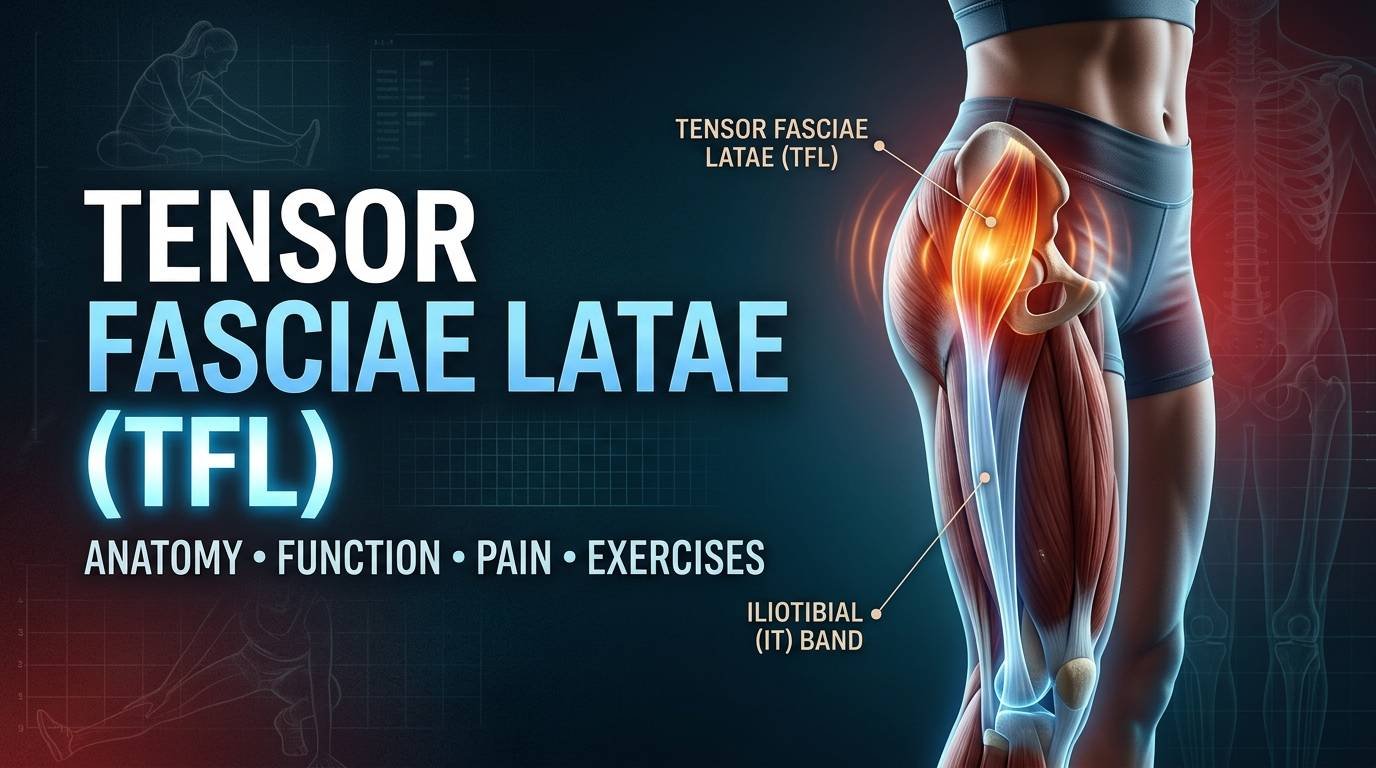

The tensor fasciae latae (TFL) is a small muscle on the front and outer side of your hip. It’s easy to overlook, yet it helps you stand on one leg, walk, run, climb stairs and pedal a bike. When it gets overworked, it’s also a common source of that nagging ache on the outside of the hip.
This guide covers exactly where the TFL sits, what it does, why it hurts, how to test it at home, and the stretches and exercises that actually fix the problem (hint: it isn’t just stretching).
Key Takeaways
- The TFL runs from the front of your pelvis into the iliotibial (IT) band on the outside of your thigh.
- Its main job is stabilizing the pelvis when you’re on one leg, plus helping flex, abduct and internally rotate the hip.
- TFL pain is usually an overload problem: weak or sleepy glutes push the TFL to work harder than it should.
- Stretching and rolling give short-term relief. Glute strengthening is what keeps the pain from coming back.
- Deep groin pain, night pain, numbness or pain after a fall are not typical TFL symptoms. See a clinician.
What Is the Tensor Fasciae Latae?
The tensor fasciae latae (pronounced roughly “TEN-sor FASH-ee-ee LAY-tee”) is a thigh muscle that belongs to the gluteal group, alongside the gluteus maximus, medius and minimus. You’ll also see it written as tensor fascia lata or simply the TFL muscle. All of these refer to the same structure.
The name is Latin. Tensor means “stretcher,” and fascia lata is the broad sheet of connective tissue that wraps your thigh like a sleeve. So the tensor fasciae latae is literally the muscle that tightens the fascia on the side of your thigh. That tightening matters because the thickest part of that fascial sleeve is the IT band, and the TFL helps control its tension.
It’s one of the most superficial muscles at the front of the hip, sitting just under the skin. That’s why you can feel it easily, and why it often gets blamed when the outside of the hip hurts.
Where Is the TFL Muscle Located?
Stand up and find the bony point at the front of your pelvis, the one you’d rest your hand on if you put your hands on your hips. That’s the anterior superior iliac spine (ASIS). The TFL begins there.
To feel the muscle belly, slide your fingers roughly halfway between that bony point and the large bump on the side of your upper thigh (the greater trochanter). Rotate your thigh inward slightly or lift your knee a little, and you should feel a firm, rope-like muscle tighten under your fingers. That’s your TFL.
TFL Anatomy: Origin, Insertion, Nerve and Blood Supply
Here’s the quick reference table that anatomy students and clinicians use.
| Feature | Details |
|---|---|
| Origin | Anterior superior iliac spine (ASIS) and the outer lip of the front part of the iliac crest |
| Insertion | Iliotibial (IT) band, which continues down to Gerdy’s tubercle on the outer top of the shinbone (tibia) |
| Main actions | Hip abduction, hip flexion, hip internal rotation, pelvic stabilization |
| Nerve supply | Superior gluteal nerve (spinal levels L4, L5, S1) |
| Blood supply | Ascending branch of the lateral circumflex femoral artery, with contribution from the superior gluteal artery |
| Location | Front and outer hip, between the sartorius and gluteus medius |
For a deeper academic overview, see this StatPearls anatomy review of the tensor fasciae latae from the National Library of Medicine.
How the TFL connects to the IT band
The TFL doesn’t attach to bone at its lower end the way a biceps does. Instead, its fibers blend into the layers of the fascia lata, and the muscle sits sandwiched between two of those layers. The thick, strap-like portion of that fascia is the IT band.
Here’s the part many articles skip: the IT band is not a muscle. It can’t contract. It’s a tough band of connective tissue that gets tensioned by two muscles pulling on it from above, the TFL (from the front) and the gluteus maximus (from the back).
| Tensor fasciae latae (TFL) | IT band | |
|---|---|---|
| What it is | A muscle | A thickened band of fascia |
| Can it contract? | Yes | No |
| Where it hurts | Front and outer hip | Usually outer knee (IT band syndrome) |
| Main job | Tensions the IT band and steadies the pelvis | Passively stabilizes the outer hip and knee |
Two heads, two jobs
Research on the muscle’s fiber layout suggests the TFL behaves as if it has two regions. The front (anteromedial) fibers are most active when you lift your leg forward, as in the swing phase of walking and running. The back (posterolateral) fibers are more active during the stance phase, when you’re balancing on one leg. This is one reason the muscle can both help you sprint and keep your pelvis level when you stand on one foot.
What Does the Tensor Fasciae Latae Do? (Function)
1. Stabilizes your pelvis on one leg
This is the TFL’s most important job. Every step you take puts you on one leg for a moment. The TFL, working with the gluteus maximus, helps keep your pelvis level so the opposite hip doesn’t drop. Its location gives it a big mechanical advantage: it’s the most forward and most outward muscle at the hip, so even a small muscle has a strong influence on pelvic position.
2. Moves the hip
The TFL helps with three hip movements:
- Flexion: lifting the thigh forward, together with the rectus femoris and iliopsoas.
- Abduction: moving the leg out to the side, together with the gluteus medius and minimus.
- Internal rotation: turning the thigh inward.
3. Tensions the IT band and protects the thigh bone
When you stand on one leg, your body weight creates a bending force on the thigh bone (femur). By tightening the IT band, the TFL and gluteus maximus help absorb part of that load. Some researchers believe this is why humans, who walk upright, have such a well-defined IT band.
What about the knee?
Older textbooks say the TFL extends and rotates the lower leg at the knee. More recent anatomical work suggests its influence at the knee is mostly indirect, through the tension it creates in the IT band. In practical terms, think of the TFL as a hip muscle first and a knee helper second.
Everyday and sport examples
You rely on your TFL when you climb stairs, step off a curb, stand on one leg to put on pants, run, cycle, hurdle, ride a horse or water-ski. Sports that involve repeated single-leg loading or sideways slopes (trail running on cambered paths, for example) tend to demand a lot from it.
TFL Pain: Symptoms and Causes
Common symptoms
An irritated, strained or overworked TFL usually shows up as:
- A deep ache or tenderness at the front and outer hip, about a hand’s width below the bony point of the pelvis
- Pain that increases with stairs, hills, running or standing on one leg
- A tight, pulling feeling that runs down the outer thigh toward the knee
- Tenderness when you press into the muscle
- Discomfort lying on that side, in some people
Why does the TFL get overworked?
The TFL is rarely the root problem. It’s usually the messenger. The most common triggers include:
- Weak or underused glutes. When the gluteus maximus and medius don’t pull their weight, the TFL steps in and takes extra load it wasn’t built for.
- Prolonged sitting. Hours in a chair keep the hip flexed, leaving the TFL and hip flexors shortened and the glutes quiet.
- Sudden jump in training. Adding mileage, hills or heavy lunges too fast.
- Cycling position problems. A saddle that’s too high or cleats that aren’t aligned can increase outer-hip strain on every pedal stroke.
- Repeated running on sloped surfaces. Running the same direction on a cambered road or track loads one hip more than the other.
- Poor single-leg control. Knees drifting inward during squats, lunges or running often means the hip stabilizers aren’t coping.
The chain reaction
When the TFL dominates the movement, the thigh tends to drift into a flexed, inward-turned position while you’re standing on that leg. The pelvis can tip forward, the knee can fall inward, and stress shifts to other areas. A tight, overactive TFL has been linked in clinical writing to outer-knee pain, kneecap (patellofemoral) pain, and low back discomfort from excess forward pelvic tilt. Because the body works as a connected chain, tension in one region can show up elsewhere. If your tightness also travels higher, our guide to upper back pain explains how posture and muscle imbalance can feed into each other.
When It Might NOT Be the TFL
Outer hip pain has several look-alikes. Don’t assume the TFL is the culprit if you notice:
- Pain right on the bony bump at the side of the hip, worse lying on that side at night. This pattern can point to gluteal tendinopathy (often mislabeled as bursitis).
- Deep groin pain, clicking, catching or a pinching feeling when you bring the knee up. This suggests a problem inside the hip joint, such as a labral tear or impingement.
- Pain that changes when you bend or twist your back. Lower back problems can refer pain into the outer hip.
- Worsening pain at rest after high-volume running. Rarely, this can be a stress fracture and needs imaging.
Seek medical care promptly if the pain is severe, follows a fall or injury, wakes you every night, or comes with numbness, tingling, weakness or swelling.
How to Test Your TFL at Home
These simple checks can hint at whether your hip stabilizers are the issue. They are screening tools, not diagnoses.
1. Single-leg stand (30 seconds). Stand on the sore leg in front of a mirror. If the opposite hip drops or your upper body leans over the standing leg, your hip stabilizers are struggling.
2. Side-lying leg lift. Lie on your side with the top leg straight and lift it toward the ceiling. If the leg drifts forward and you feel the work at the front of the hip instead of the buttock, the TFL is probably doing the glutes’ job.
3. Film your squat. Record yourself from the front. Knees that cave inward as you descend are a common sign of weak hip control.
Clinical tests physical therapists use
- Ober’s test: with you lying on your side, the clinician lowers your top leg behind you toward the table. If it can’t drop down, the TFL and IT band may be tight.
- Modified Thomas test: lying at the edge of a table with one knee hugged to the chest, the clinician checks whether the other thigh hangs level. A thigh that stays lifted or swings outward suggests tightness at the front of the hip, including the TFL.
How to Stretch the Tensor Fasciae Latae
Stretching feels good and can make the muscle less tense, which makes it easier to do the strengthening work that matters. Aim for gentle, steady stretches, never sharp pain.
Half-kneeling TFL stretch
- Kneel on the sore side’s knee (use a cushion) with the other foot flat in front.
- Tuck your pelvis under and squeeze the glute of the kneeling leg.
- Shift your weight slightly forward until you feel a stretch at the front of the hip.
- To bias the TFL, reach the arm on the kneeling side overhead and lean gently away from the stretched hip.
- Hold 30 seconds. Repeat 2 to 3 times per side.
Tip: Keep your ribs down. If your lower back arches, you’ve lost the stretch.
Standing cross-over stretch
- Stand side-on to a wall with the sore hip farthest from it.
- Cross the sore leg behind the other leg.
- Push the sore hip out to the side while leaning your upper body toward the wall.
- Hold 30 seconds. Repeat 2 to 3 times per side.
Self-massage
Lie on your side with a lacrosse or massage ball under the front-outer hip. Apply gentle, steady pressure for 30 to 60 seconds, keeping your hip, knee and ankle in a straight line. More pressure is not better. Grinding hard into an irritated muscle usually backfires.
Best TFL Exercises: Strengthen the Glutes, Calm the TFL
Here’s the key insight from the research: you don’t need to strengthen the TFL. You need to strengthen the muscles around it so it can stop compensating. Studies using muscle-activity sensors have compared hip exercises to find the ones that fire the glutes while keeping the TFL relatively quiet. Clamshells, side-stepping, single-leg bridges and quadruped hip extensions are among the exercises commonly recommended for that goal.
| Exercise | Main target | Sets and reps (starting point) |
|---|---|---|
| Glute bridge, progressing to single-leg bridge | Gluteus maximus | 3 × 8–12 |
| Clamshell | Gluteus medius | 2–3 × 12–15 |
| Side-lying leg lift (toes slightly down) | Gluteus medius | 2–3 × 10–12 |
| Banded side steps | Gluteus medius | 3 × 10–15 steps each way |
| Quadruped hip extension (“donkey kick”) | Gluteus maximus | 2–3 × 10–12 |
| Step-downs and split squats | Single-leg control | 3 × 8–10 each leg |
Form cues that make the difference
- Feel it in the buttock, not the front of the hip. If your hip flexor or TFL burns first, reduce the range, slow down, or pull the toes slightly inward or down.
- Keep the pelvis level. Don’t let it roll backward during side-lying exercises.
- Knees track over the toes. No inward collapse on bridges, step-downs or squats.
- Progress with resistance. Bodyweight is a starting point. Add a band, then weight, as it gets easy.
A Simple 4-Week Plan
| Week | Focus | What to do |
|---|---|---|
| 1 | Calm it down | Modify aggravating activity (shorter runs, flatter routes), gentle stretching, light self-massage, begin bridges and clamshells |
| 2 | Build control | Add banded side steps and side-lying leg lifts; film your squat to check knee position |
| 3 | Add load | Single-leg bridges, step-downs, split squats |
| 4 | Return to activity | Gradually rebuild running, cycling or lifting volume as long as pain stays low during and after |
Rest completely only if movement is very painful. Total rest weakens the very muscles you need. Many mild, recent cases improve over a few weeks with consistent work, while longstanding problems can take longer. If you’re not improving after 4 to 6 weeks, get assessed.
Preventing TFL Problems
- Break up sitting. Stand, walk or stretch your hips every 30 to 45 minutes.
- Warm up the glutes before runs, rides and leg days.
- Increase training gradually. Avoid sudden jumps in volume, hills or intensity.
- Vary your running surfaces and direction on cambered paths.
- Check your bike fit if you ride regularly.
- Include single-leg work in your weekly strength routine.
Interesting TFL Facts
- The TFL is often called a “small muscle with a big influence” because of its leverage at the front of the hip.
- Humans are considered unusual among mammals for having such a distinct IT band, which may relate to walking upright.
- Surgeons sometimes use TFL tissue as a flap in reconstructive procedures because of its reliable blood supply.
- The TFL is more active when you lift your leg forward than when your heel strikes the ground, when it quiets down to let the hip extend.
Frequently Asked Questions
What does the tensor fasciae latae do?
It helps flex, abduct and internally rotate the hip, and its most important job is stabilizing the pelvis when you stand on one leg. It also tensions the IT band, which supports the outer hip and knee.
Where is the tensor fasciae latae muscle located?
At the front and outside of your hip, just below the bony point at the front of your pelvis. It runs down into the IT band on the outer thigh.
What is the difference between the TFL and the IT band?
The TFL is a muscle that can contract. The IT band is a thick strip of connective tissue that cannot. The TFL and gluteus maximus pull on the IT band to control its tension.
What causes TFL pain?
Usually overuse and overload. Weak glutes, long periods of sitting, sudden training increases, poor cycling position and running on slopes are the usual suspects.
How do you release a tight TFL?
Combine gentle hip flexor and TFL stretching with light ball release for 30 to 60 seconds at a time, then follow up with glute strengthening so the tightness doesn’t return.
How long does a TFL strain take to heal?
Mild, recent cases often settle in a few weeks with load modification and strengthening. Pain that has lasted for months may take longer and is worth having assessed by a physical therapist.
Can I keep exercising with TFL pain?
Usually yes, with changes. Reduce volume, avoid steep hills and cambered surfaces, and stop short of pain that climbs during or after the activity.
Is TFL pain the same as IT band syndrome?
No, though they’re related. TFL pain is felt at the hip. IT band syndrome typically causes pain on the outside of the knee. An overworked TFL can contribute to IT band irritation.
Should I stretch or strengthen my TFL?
Both help, but strengthening the glutes is what resolves the underlying problem. Stretching alone often brings only temporary relief.
When should I see a doctor?
See a healthcare professional if pain follows a fall, is severe, wakes you at night, doesn’t improve in 4 to 6 weeks, or comes with numbness, weakness, swelling or deep groin pain.
Final Thoughts
The tensor fasciae latae may be small, but it carries a big responsibility at the front of the hip. Understanding what it does, and why it gets overworked, shifts the goal from “stretch the sore muscle” to “fix the hip stability that’s overloading it.” Pair gentle mobility work with consistent glute strengthening, adjust the habits that stress your hips, and most TFL problems become manageable.
Medical disclaimer: This article is for general education and is not a substitute for professional medical advice, diagnosis or treatment. If you have persistent, severe or unexplained hip or leg pain, consult a qualified healthcare provider.
Sources and Further Reading
- StatPearls: Anatomy, Bony Pelvis and Lower Limb: Tensor Fasciae Latae Muscle
- Pare EB, et al. (1981). Anatomical and electromyographic study of the tensor fasciae latae. Journal of Bone and Joint Surgery.
- Fairclough J, et al. (2006). The functional anatomy of the iliotibial band during flexion and extension of the knee. Journal of Anatomy.
- Selkowitz DM, Beneck GJ, Powers CM. (2013). Which exercises target the gluteal muscles while minimizing activation of the tensor fascia lata? Journal of Orthopaedic & Sports Physical Therapy.
- Flack NAMS, Nicholson HD, Woodley SJ. (2012). A review of the anatomy of the hip abductor muscles. Clinical Anatomy.