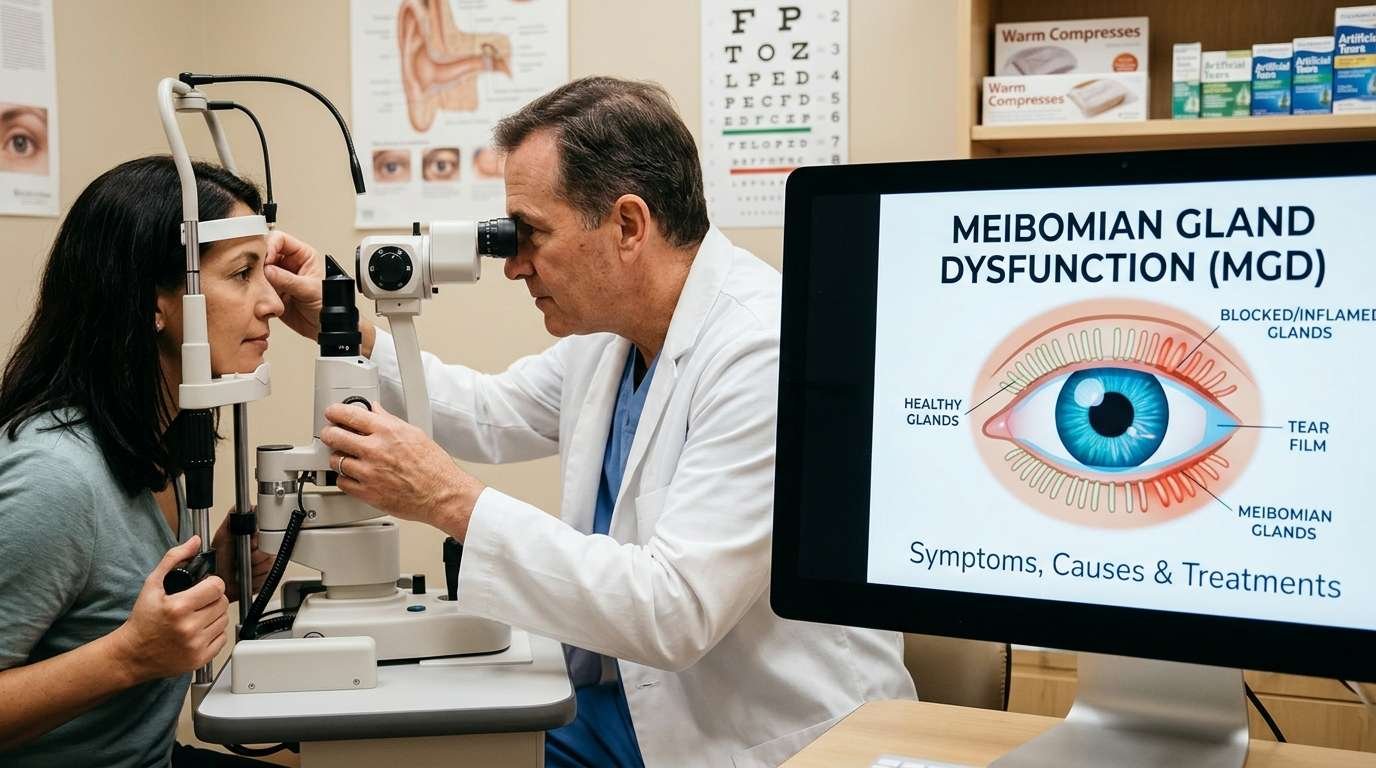

Meibomian gland dysfunction (MGD) happens when the tiny oil glands along your eyelid edges get clogged or make poor-quality oil. Without enough healthy oil, your tears evaporate too fast, and your eyes end up dry, gritty, red, and tired. It is one of the most common causes of dry eye, and one of the most overlooked.
The good news: MGD is manageable. The catch is that it’s usually a long-term condition, and the earlier you act, the more of your glands you keep.
Key Takeaways
- MGD is a leading cause of evaporative dry eye, and it often has no symptoms in the early stages.
- The oil glands can shrink permanently if blockages are left untreated, so early care matters.
- Warm compresses, gentle lid massage, and lid cleaning are the foundation of treatment, but they’re often not enough on their own.
- In-office options include thermal pulsation, intense pulsed light (IPL), lid exfoliation, and gland probing.
- Artificial tears help the surface, but they don’t fix a blocked gland.
- See an eye doctor if dryness, burning, or recurring styes last more than a few weeks.
What Is Meibomian Gland Dysfunction?
Meibomian glands (say “my-BOH-mee-un”) are rows of microscopic glands lined up inside your upper and lower eyelids, with openings right at the lash line. Every time you blink, they release a thin film of oil called meibum onto the surface of your eye.
MGD means those glands aren’t doing their job. Usually, the oil thickens and hardens into a waxy plug that blocks the opening (this is called obstructive MGD, the most common type). Less often, the glands make too little oil or oil of poor quality.
A detailed overview from StatPearls on meibomian gland disease covers the clinical background if you want to go deeper.
Why that oil matters
Your tear film isn’t just water. It has three layers working together:
| Layer | What it does | Where it comes from |
|---|---|---|
| Oil (lipid) layer | Seals the surface so tears don’t evaporate | Meibomian glands |
| Water (aqueous) layer | Hydrates and nourishes the eye | Lacrimal glands |
| Mucus (mucin) layer | Helps tears cling to the eye | Surface cells |
Think of the oil layer like the lid on a cup of coffee. Remove it, and the liquid underneath cools and disappears far faster. When the oil layer is thin, tears break apart in seconds, the eye surface gets exposed, and irritation follows.
How Common Is MGD?
More common than most people think. One global estimate suggests roughly 36% of people have some degree of MGD, and about 70% of people over 60 in the U.S. are affected. Among people diagnosed with dry eye, a large share (some reports say up to 86%) have gland dysfunction as a contributing factor.
Many people live with it for years and assume it’s “just dry eyes.” That’s exactly why it is considered underdiagnosed.
MGD Symptoms: What It Actually Feels Like
In the early stages, you may feel nothing at all. As the glands lose function, symptoms tend to creep in slowly:
- Burning or stinging eyes
- A gritty, sandy feeling, like something is stuck in your eye
- Red or irritated eyelid edges
- Itchy eyes
- Watery eyes (yes, really: irritated eyes sometimes flood with thin tears that don’t stick)
- Blurry vision that clears when you blink
- Crusty or sticky lids, especially in the morning
- Eyes that feel worse later in the day or after screen time
- Contact lenses that suddenly feel uncomfortable
- Styes or chalazia (eyelid bumps) that keep coming back
A classic clue: your vision blurs while reading or scrolling, then sharpens after a few blinks. That’s an unstable tear film, and it’s often a sign of poor oil quality.
MGD vs. Dry Eye vs. Blepharitis vs. Stye vs. Chalazion
These conditions overlap, and you can have several at once. Here’s how to tell them apart.
| Condition | What it is | Typical signs |
|---|---|---|
| MGD | Clogged or underperforming oil glands | Gritty, burning eyes; thick or cloudy oil; recurring lid bumps |
| Evaporative dry eye | Tears evaporate too fast (MGD is the leading cause) | Dryness, fluctuating vision |
| Aqueous-deficient dry eye | Not enough watery tears | Dryness even without lid problems |
| Blepharitis | Inflamed eyelid margins | Red, swollen lids, flaky crusts at the lashes |
| Stye | Painful infected gland or follicle | Tender red bump on the lid edge |
| Chalazion | Blocked oil gland that swells | Firm, usually painless lump in the lid |
Researchers still debate which comes first. Gland blockage can drive dry eye, and chronic dry eye inflammation can in turn damage the glands, which is why it often becomes a vicious cycle.
What Causes Meibomian Gland Dysfunction?
MGD rarely has one cause. It’s usually a stack of small contributors.
Aging. Gland numbers and function decline with age, which is why MGD becomes much more common after 50.
Hormonal changes. Low androgen levels and menopause-related shifts can change the makeup of the oil, making it thicker and stickier.
Skin and immune conditions. Rosacea is strongly linked to MGD. So are psoriasis, lupus, rheumatoid arthritis, and Sjögren’s syndrome.
Eyelid mites (Demodex). These microscopic mites live on lashes and can irritate the lid margin and clog gland openings when they overpopulate.
Contact lens wear. Studies link long-term lens wear with gland changes, possibly through eye rubbing, lens buildup, or tear film disruption.
Eye makeup. Eyeliner applied along the lash line can plug gland openings, especially if it isn’t fully removed at night. (Scrubbing too aggressively can cause its own damage, so be gentle.)
Screen time. We blink far less when staring at a screen, and blinking is the pump that squeezes oil out of the glands. Fewer blinks means more stagnant oil.
Medications. Retinoids (found in some acne treatments and anti-aging creams), estrogen replacement therapy, anti-androgen drugs, and certain antihistamines and glaucoma medications can affect oil production.
High cholesterol and blood pressure. Both are associated with a higher risk of MGD.
Environment. Dry indoor air, heating, air conditioning, wind, and smoke all speed up tear evaporation and stress the glands.
Who’s most at risk?
- Adults over 50
- People with rosacea or autoimmune conditions
- Contact lens wearers
- Heavy screen users
- People of Asian descent (some studies report rates up to about 69%, compared with roughly 20% to 30% in white populations, though numbers vary by study)
- People who wear eyeliner daily
MGD isn’t limited to older adults. It also occurs in younger adults and, less often, in children.
How MGD Progresses
MGD tends to move through stages:
- Silent stage. Glands are partly blocked, but you feel fine. An eye exam can already show changes.
- Mild symptoms. Occasional dryness, grit, or stickiness. Oil becomes cloudy.
- Moderate disease. Daily discomfort, visible lid inflammation, thick toothpaste-like oil, and possible styes.
- Advanced disease. Many glands shrink and disappear (atrophy). Surface damage becomes more likely.
Here’s the part most articles skip: a gland that has atrophied can’t be brought back. Treatment at an earlier stage protects the glands you still have. That’s the strongest argument for getting checked sooner rather than later.
How Is MGD Diagnosed?
Your optometrist or ophthalmologist will ask about your symptoms, health history, medications, and daily habits, then examine your lids under magnification. Common tests include:
- Gland expression. The doctor gently presses on the eyelid to see what comes out. Healthy oil is clear and flows like olive oil. In MGD it can look cloudy, thick, paste-like, or may not come out at all.
- Tear break-up time (TBUT). A drop of dye lets the doctor time how quickly your tear film breaks apart after a blink. Fast breakup points to an oil problem.
- Schirmer test. Paper strips measure how much watery tear you produce.
- Meibography. Infrared imaging photographs the glands themselves, showing shortened or missing ones. It also gives a baseline to track over time.
- Tear osmolarity and MMP-9 testing. These check tear concentration and surface inflammation.
There’s no single test for MGD. Doctors put the pieces together.
How to Treat MGD: A Step-by-Step Approach
Most doctors build treatment in layers, starting simple and adding more if needed.
Step 1: Warm compresses (the foundation)
Heat melts the waxy plugs so the oil can flow again.
- Wash your hands, then soak a clean washcloth in warm (not hot) water, or warm a microwavable eye mask according to its directions.
- Close your eyes and rest it over your lids for at least 5 minutes. Re-warm a washcloth as it cools, since a lukewarm cloth won’t reach the glands.
- Do this once or twice daily. Many doctors suggest twice daily when symptoms are bad, then once daily to keep them away.
Be patient. Because MGD is chronic, benefits build over weeks to months, not days.
Step 2: Gentle lid massage
Right after the compress, while the oil is soft:
- Lower lid: look up and roll a clean fingertip gently upward toward the lash line.
- Upper lid: look down and roll a fingertip gently downward toward the lash line.
Use light pressure. Pressing hard causes pain and irritation and doesn’t help the glands.
Step 3: Lid hygiene
Cleaning the lash line removes oil, crust, and bacteria that clog gland openings. Use a pre-moistened lid wipe, or a clean cloth with a mild, non-irritating cleanser or a few drops of diluted baby shampoo, and wipe along the base of the lashes once a day or as your doctor recommends. Skip DIY “remedies” like essential oils unless your eye doctor specifically suggests them, because they can burn the eye.
Step 4: Fix the habits feeding the problem
- Blink on purpose. Try the 20-20-20 rule: every 20 minutes, look at something 20 feet away for 20 seconds, and blink fully a few times.
- Add humidity. A humidifier helps offset heating and air conditioning.
- Redirect airflow. Keep fans and car vents from blowing at your face.
- Remove eye makeup every night, and consider pausing eyeliner on the inner lash line while symptoms flare.
- Review contact lens habits with your doctor. Some people feel better in daily disposables.
- Ask about medications. If a retinoid or another drug may be contributing, talk to your prescriber rather than stopping it on your own.
Step 5: In-office treatments for stubborn MGD
When home care doesn’t get you far enough, your doctor may suggest a procedure. These are generally quick and don’t require downtime.
| Treatment | How it works | Typical session | How long relief may last |
|---|---|---|---|
| Automated thermal pulsation | A device heats the inner lids while applying pulsed pressure to push out blockages | About 12 minutes | Research suggests up to 3 years for some patients |
| Manual thermal pulsation | Handheld LED heat device, then the doctor expresses the glands | Under 8 minutes | Roughly 6 to 12 months |
| TearCare | Adhesive heating patches on the lids, followed by manual expression | About 15 minutes of heating | Roughly 6 to 12 months |
| Intense pulsed light (IPL) | Light pulses calm lid inflammation (borrowed from rosacea care) | About 10 minutes; often a series spaced about 2 weeks apart | Varies; one 3-year study reported high satisfaction |
| Lid exfoliation | A handheld device gently scrubs away biofilm on the lid edge | Under 10 minutes | Usually repeated periodically |
| Lid debridement | Instrument removes keratin and debris that block openings | Short in-office visit | Often combined with other care |
| Gland probing | A very fine probe opens blocked ducts | In-office | Case-dependent |
Duration and results vary by person and by device. Ask your clinic what they use, what a realistic outcome looks like for your stage, and what it costs. Insurance coverage differs a lot from plan to plan, so confirm before you book.
Step 6: Prescription medications
Depending on severity and underlying causes, your doctor may prescribe:
- Anti-inflammatory eye drops such as cyclosporine or lifitegrast, or a short course of steroid drops for a flare
- Antibiotic or anti-parasitic treatments for lid bacteria or Demodex
- Oral antibiotics such as doxycycline or azithromycin, used for their anti-inflammatory effects in moderate to severe MGD
- Evaporation-reducing drops, such as the waterless prescription drop perfluorohexyloctane (brand name Miebo)
- Preservative-free artificial tears to comfort the surface while the glands recover
Artificial tears are worth keeping on hand, but they treat the symptom, not the blockage underneath.
What about omega-3 supplements?
Some eye doctors recommend omega-3s (fish oil or flaxseed oil) to help improve oil quality, and the evidence is mixed. Large studies on dry eye overall haven’t shown a clear benefit over placebo, so treat omega-3s as a possible extra, not a replacement for compresses and lid care. Talk to your doctor first, especially if you take blood thinners or diabetes medication.
A Simple Daily MGD Routine
Morning: warm compress (5 to 10 minutes), gentle massage, lid wipe.
During the day: blink breaks every 20 minutes, preservative-free tears as needed, avoid direct airflow.
Evening: remove eye makeup fully, second warm compress and massage if your doctor advises it.
Stick with it for at least a month before judging results, and keep a short symptom diary so you can show your doctor what’s changing.
Can MGD Be Cured or Prevented?
Honestly, MGD is usually managed rather than cured, especially when an underlying condition like rosacea or an autoimmune disease is involved. The outlook is generally good, though, and many people reach comfortable, stable eyes with a consistent routine.
You can’t change your age or genetics, but you can lower your risk and slow progression by keeping your lids clean, taking screen breaks, controlling cholesterol and blood pressure, removing makeup nightly, caring for contact lenses as directed, and getting regular eye exams.
Possible Complications of Untreated MGD
- Chronic dry eye disease
- Blepharitis (inflamed eyelids)
- Recurring styes and chalazia
- Permanent gland loss
- Eye surface and corneal damage in advanced cases
- Higher risk of infection or inflammation after eye surgery, which is worth knowing if you’re planning cataract or LASIK surgery
When to See an Eye Doctor
Book an exam if you have:
- Dryness, burning, or grittiness lasting more than a few weeks
- Eye drops that only help for a short time
- Repeated styes or chalazia
- Contact lenses that no longer feel comfortable
- Blurry vision that comes and goes
Seek urgent care right away for sudden vision loss, severe eye pain, a very red painful eye, or light sensitivity with vision changes. Those are not typical MGD symptoms.
Also keep in mind that pain felt deep behind the eyes, especially alongside headaches, usually points to something other than your eyelid glands. Our guide to headache behind the eyes explains common causes and when to get checked.
Frequently Asked Questions
What is the main cause of meibomian gland dysfunction?
The most common mechanism is blockage: the oil thickens and plugs the gland openings. What triggers it varies, including aging, hormones, rosacea, contact lenses, eyelid mites, and reduced blinking from screen use.
How do you unclog meibomian glands?
Start with warm compresses followed by gentle massage and lid cleaning. If that doesn’t work, an eye doctor can use thermal pulsation, IPL, exfoliation, or probing to clear stubborn blockages.
Does meibomian gland dysfunction go away on its own?
Usually not. Without care it tends to progress. With consistent treatment, symptoms can improve a lot, but ongoing maintenance is often needed.
Is MGD the same as dry eye?
Not exactly. MGD is a leading cause of one type of dry eye, called evaporative dry eye. You can have both MGD and low tear production at the same time.
Can meibomian gland dysfunction cause blurry vision?
Yes, often temporarily. An uneven tear film scatters light, so vision may blur and then sharpen after a blink.
Is MGD contagious or an infection?
No. MGD is not an infection, although bacteria and inflammation play a role, which is why antibiotics are sometimes prescribed.
Can children get MGD?
Yes. It’s seen in kids and teens, often alongside recurring styes or lid inflammation. A pediatric eye doctor can recommend safe care, including how to handle compresses and supplements.
How long do warm compresses take to work?
Some people notice relief within a couple of weeks, but because MGD is chronic, many need several weeks to months of steady use.
Can I wear contact lenses with MGD?
Often yes, with adjustments. Treating the glands usually improves lens comfort. Ask your doctor about lens type and wearing schedule.
Are artificial tears enough?
Rarely for MGD. They soothe the surface for a while, but they don’t unblock the glands.
The Bottom Line
Meibomian gland dysfunction is common, sneaky, and very treatable when it’s caught early. A steady routine of warm compresses, gentle massage, lid hygiene, and better screen and makeup habits can go a long way, and modern in-office treatments give you more options than ever if home care isn’t enough. If your eyes have been dry, gritty, or irritated for weeks, don’t just reach for another bottle of drops. Get your eyelid glands checked.
Sources and Further Reading
- Cleveland Clinic. Meibomian Gland Dysfunction (medically reviewed health library article).
- All About Vision. Meibomian Gland Dysfunction (medically reviewed by Thomas J. Stokkermans, OD, PhD, FAAO).
- American Association for Pediatric Ophthalmology and Strabismus. Meibomian Gland Dysfunction and Treatment.
- WebMD. What Is Meibomian Gland Dysfunction? (medically reviewed).
- Washington Eye Institute. Understanding Meibomian Gland Dysfunction and Treatment.
- Gurnani B, Kaur K. Meibomian Gland Disease. StatPearls, NCBI Bookshelf.
- Tear Film and Ocular Surface Society (TFOS). International Workshop on Meibomian Gland Dysfunction reports.
Medical disclaimer: This article is for general education only and is not a substitute for professional medical advice, diagnosis, or treatment. Always seek the advice of a qualified eye care professional about your condition.