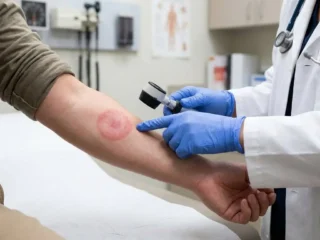

You notice it in the shower or while getting dressed: a round red mark on your skin. It doesn’t itch, it doesn’t hurt, and you have no idea where it came from. Because most of us associate ring-shaped rashes with ringworm, and ringworm is famously itchy, the lack of itching can feel confusing.
Here is the short version. A red circle on the skin that isn’t itchy is often caused by a harmless, self-limiting condition such as granuloma annulare, pityriasis rosea, or a reaction to an insect bite. But a few causes, including early Lyme disease, need prompt treatment. The details of how the ring looks, where it is, and how fast it changes matter a lot.
This guide walks you through the most likely causes, a simple five-question check you can do right now, what to avoid putting on the patch, and the signs that mean you should book an appointment.
Quick answer: The most common non-itchy red circles are granuloma annulare, early Lyme disease (erythema migrans), erythema annulare centrifugum, pityriasis rosea’s first patch, fixed drug eruptions, and insect bite reactions. Ringworm and eczema usually itch, but not always. If the ring is expanding, you had a tick bite, or you feel unwell, get it checked soon.
Why Isn’t My Red Circle Itchy?
Itch (the medical term is pruritus) depends on the cause of the inflammation, not on the shape of the rash. Some conditions switch on the itch nerves strongly. Others create redness and bumps while mostly bypassing them.
A few reasons a ring can stay quiet:
- The immune reaction is deeper in the skin. Granuloma annulare, for example, involves inflammation in the dermis rather than the surface layer, so it is often painless and itch-free.
- The rash is in an early stage. Ringworm and eczema can be mild or itch-free at first.
- Skin tone and thickness vary. Some people simply feel less itch from the same rash.
- Prior treatment changed the picture. Steroid cream can calm itching while the underlying problem continues (more on this below).
So “not itchy” is a clue, not a clear answer. It narrows the list but doesn’t rule anything in or out.
9 Possible Causes of a Red Circle on Skin That Doesn’t Itch
1. Granuloma Annulare
Granuloma annulare (GA) is one of the best-known non-itchy ring rashes. It appears as a ring made of small, firm bumps that may be skin-colored, pink, red, or purplish. The ring can range from a fraction of an inch to a few inches across.
- Where: Backs of the hands, fingers, feet, ankles, elbows.
- Feels like: Smooth, firm bumps. Usually painless and not scaly.
- Cause: Not fully understood. It has been linked to minor skin injury, insect bites, and sometimes infections or other health conditions.
- Outlook: Often fades by itself over months to a couple of years, though it can return. It is not contagious.
Clue that points to GA: a ring of bumps with a smooth, non-scaly surface.
2. Early Lyme Disease (Erythema Migrans)
This is the one you don’t want to miss. Lyme disease is spread by blacklegged (deer) ticks, and its signature rash, erythema migrans, is typically not itchy. According to the CDC, <cite index=”3-1″>erythema migrans rash occurs in over 70 percent of people with Lyme disease.</cite>
- Appearance: An expanding red patch, sometimes with central clearing (the classic “bull’s-eye”), but it can also be a solid oval, bluish-tinged, or have a central crust.
- Timing: It usually shows up days to a few weeks after a tick bite, and many people never notice the bite.
- Where: Anywhere, including the back of the knee, armpit, groin, or scalp where you can’t easily see it.
- Other signs: Fatigue, fever, chills, headache, or muscle and joint aches.
Lyme rashes look different on dark skin and may resemble a bruise rather than a red ring. The CDC publishes a photo guide to Lyme disease rashes on light and dark skin that is worth reviewing if you live in or have visited the Northeast, Upper Midwest, or mid-Atlantic states.
Clue that points to Lyme: a ring that keeps growing over days, especially after outdoor exposure in tick country. Early antibiotic treatment works well, so don’t wait.
3. Erythema Annulare Centrifugum (EAC)
EAC is a reactive rash that forms slowly expanding pink or red rings, often on the thighs, hips, or upper arms. It may itch mildly or not at all.
- Classic clue: a thin line of scale on the inside edge of the ring (called “trailing scale”), rather than on the outer border as in ringworm.
- Triggers: Often none are found, but infections, medication reactions, and other health issues have been associated with it.
- Course: It can come and go for weeks, months, or longer.
4. Pityriasis Rosea (the Herald Patch)
Many cases of pityriasis rosea begin with a single oval, slightly scaly pink or salmon-colored patch on the chest, belly, or back, called the herald patch. It can look like a ring and often doesn’t itch much, or at all, at first.
- What follows: Within days to a couple of weeks, smaller oval spots appear, often in a pattern along the ribs that resembles a Christmas tree.
- Who gets it: Most often teens and young adults.
- Outlook: It typically fades without treatment in about six to ten weeks. It is not considered contagious.
5. Insect or Spider Bite Reaction
Some bites produce a round red area with a darker or clear center. A flea, mite, or mosquito bite can swell into a large circle, particularly in children, and some never itch. Local reactions usually peak within a day or two and shrink after that. A ring that keeps expanding beyond that window should be examined, since it can overlap with the Lyme picture.
6. Fixed Drug Eruption
This is an overlooked cause. A fixed drug eruption is a round or oval patch (red, purplish, or dark brown) that appears after taking a medication, then returns in the same spot each time you take that drug. Common triggers include certain antibiotics, anti-inflammatories like ibuprofen, and some anticonvulsants. It may sting or burn instead of itch, and it often leaves a darker mark after it fades.
If you notice a round patch that appears hours to days after a new medication, tell your doctor or pharmacist.
7. Early or Atypical Ringworm (Tinea Corporis)
Ringworm is a fungal infection, not a worm. It usually forms a scaly ring with a raised edge and clearer center, and it usually itches. But early patches, or patches on people who have used steroid cream, may be mild and itch-free. A fungal ring tends to have a scaly, slightly raised outer border. If the border is scaly and the ring is slowly widening, ringworm stays on the list.
8. Nummular Eczema or Psoriasis
Both can create round, coin-shaped patches. Nummular eczema typically itches, but psoriasis plaques may itch only mildly or not at all. Psoriasis patches are usually well-defined, thick, and topped with silvery-white scale, often on the elbows, knees, or scalp.
9. Less Common but Important Causes
A few other conditions can create ring-like red patches that aren’t itchy:
- Subacute cutaneous lupus: ring-shaped or scaly red patches on sun-exposed skin such as the shoulders, upper chest, and arms.
- Secondary syphilis: can occasionally appear as ring-shaped or coin-like spots, often involving the palms and soles.
- Hives (urticaria multiforme): ring-like welts that move around and disappear within 24 hours.
These are less likely, but they are a good reason to see a clinician rather than guess when a rash is persistent or comes with other symptoms.
Quick Comparison: Which Red Circle Is It?
| Condition | Itchy? | Typical look | Where it often appears | Moves or grows? |
|---|---|---|---|---|
| Granuloma annulare | Rarely | Ring of smooth, firm bumps | Hands, feet, elbows | Slowly, over weeks |
| Lyme (erythema migrans) | Rarely | Expanding red oval or ring, may clear in center | Anywhere, often hidden spots | Yes, over days |
| EAC | Sometimes | Ring with scale on the inner edge | Thighs, hips, arms | Slowly |
| Pityriasis rosea | Sometimes | Oval scaly herald patch, then small spots | Trunk | New spots in days |
| Insect bite | Often, not always | Round welt, may clear in center | Exposed skin | Shrinks in days |
| Fixed drug eruption | Rarely (may sting) | Round red-purple patch | Anywhere, same spot each time | Recurs with the drug |
| Ringworm | Usually | Scaly raised ring edge | Trunk, arms, legs | Slowly widens |
| Psoriasis | Sometimes | Thick, silvery-scaled plaque | Elbows, knees, scalp | Stable or slowly grows |
This table is a guide, not a diagnosis. Rashes overlap, and only an in-person exam can sort them out.
The 5-Question Self-Check
Before you do anything, take two minutes and answer these. They are the same questions a doctor will likely ask.
- Is it growing? Mark the edge lightly with a skin-safe pen or take a dated photo. A ring that visibly widens within a few days is more concerning than one that hasn’t changed.
- Any tick bite, outdoor time, or new pet? Hiking, gardening, or time in wooded or grassy areas matters, even if you never saw a tick.
- Any new medicine or supplement in the past two weeks? Include over-the-counter pain relievers and antibiotics.
- What does the surface feel like? Smooth and bumpy points toward granuloma annulare. Fine scale points toward EAC, pityriasis rosea, or ringworm. Thick silvery scale points toward psoriasis.
- Do you feel okay? Fever, fatigue, body aches, or headache alongside a rash changes the picture.
Write down the answers. They will make an appointment far more productive.
What Does a Red Circle Look Like on Darker Skin?
Most online pictures show rashes on light skin, which leaves many people guessing. On brown and Black skin, inflammation often appears violet, dark brown, gray, or deeper than the surrounding skin, rather than bright red. A Lyme rash may look like a bruise. A granuloma annulare ring may look slightly darker or purple-brown. After a rash fades, dark skin may keep a flat dark mark (post-inflammatory hyperpigmentation) for weeks or months.
If you have darker skin and are unsure, rely on shape, texture, and change over time rather than color alone, and consider seeing a dermatologist who has experience with skin of color.
What You Can Do at Home (and What to Avoid)
Do:
- Take a photo today and every few days in the same lighting.
- Keep the area clean and moisturized with a gentle, fragrance-free cleanser and plain moisturizer.
- Protect it from the sun with clothing or broad-spectrum SPF 30+, which helps prevent lingering dark marks.
- Check the rest of your body, including your scalp, back, and skin folds, for additional rings. Ask someone to help with places you can’t see.
- List your medications, recent illnesses, and outdoor activities.
Avoid:
- Hydrocortisone or steroid cream as a first move. If the ring is a fungal infection, steroids can mask it and let it spread (dermatologists call this tinea incognito).
- Scratching, picking, or scrubbing. This can cause irritation or infection.
- Layering multiple products such as acids, retinoids, or essential oils on the area.
- Assuming it’s nothing because it doesn’t itch. Lyme disease is a prime example of a serious cause that is typically itch-free.
When to See a Doctor
Book an appointment promptly if:
- The ring is expanding over days, or is larger than about 2 inches (5 cm).
- You had a tick bite or spent time in tick-prone areas in the past month.
- You have fever, chills, fatigue, headache, or joint pain.
- You see multiple rings appear.
- The rash is painful, blistering, oozing, or crusting.
- It doesn’t improve in two to four weeks or keeps returning.
- You are pregnant, immunocompromised, or the patch is on a child.
- It appeared after starting a new medication.
Seek urgent care or call 911 if a rash comes with trouble breathing, swelling of the lips or face, dizziness, a stiff neck with fever, or a rash that looks like bruising and spreads quickly.
How Doctors Diagnose a Red Circle
A clinician will start with your history and a close look at the rash. Depending on what they see, they may:
- Scrape the surface for a quick fungal test (a KOH exam) if ringworm is possible.
- Order blood tests if Lyme disease or another systemic condition is a concern.
- Take a small skin biopsy when the diagnosis is unclear. It can distinguish conditions like granuloma annulare, EAC, and lupus.
- Review your medications to look for a drug reaction.
Treatment depends entirely on the cause: antibiotics for Lyme, antifungals for ringworm, topical or injected steroids for granuloma annulare, and simple observation for pityriasis rosea.
Skin-Care Habits That Support Healing
While you’re waiting for an answer, a calm, minimal routine protects your skin barrier and makes it easier for a doctor to assess the rash:
- Use lukewarm (not hot) water and pat dry.
- Choose a fragrance-free moisturizer with ceramides or petrolatum.
- Pause new actives like retinol, AHAs, and benzoyl peroxide on the affected area.
- Wear loose, breathable fabrics.
- Wash towels and bedding in hot water if a fungal infection is possible.
Curious about other spots that show up on skin? Our guide to red dots on skin explains the most common causes of small red spots and how they differ from ring-shaped rashes.
Frequently Asked Questions
Can a red circle on the skin be ringworm if it doesn’t itch?
Yes. Ringworm usually itches, but early or treated patches may not. A scaly, raised border that slowly widens is the main clue. A skin scraping can confirm it.
Is a non-itchy red circle contagious?
It depends on the cause. Granuloma annulare, pityriasis rosea, EAC, and Lyme disease are not spread from person to person. Ringworm is contagious, which is why an uncertain ring deserves a proper diagnosis.
How long does a red circle on the skin last?
Insect bite reactions fade in days. Pityriasis rosea clears in roughly six to ten weeks. Granuloma annulare and EAC can last months to years. A Lyme rash can persist for weeks if untreated and should not be waited out.
Can stress cause a red circle on my skin?
Stress doesn’t create ring rashes directly, but it can aggravate conditions like eczema and psoriasis. Persistent rings need a medical evaluation rather than a stress explanation.
Should I put anti-fungal or steroid cream on it?
It’s best not to guess. Antifungal cream won’t help non-fungal rings, and steroid cream can hide a fungal infection. A quick exam can save weeks of the wrong treatment.
Is a red circle on my skin a sign of cancer?
Most red circles are not cancer. A few skin cancers, including basal cell carcinoma and some lymphomas, can appear as red patches. A patch that is persistent, slowly enlarging, bleeding, or non-healing should be examined by a dermatologist.
Can a red circle be a Lyme rash if I don’t remember a tick bite?
Yes. Many people with Lyme disease never see the tick, because nymph-stage ticks are about the size of a poppy seed. If your ring is expanding, get evaluated even without a known bite.
The Bottom Line
A red circle on the skin that doesn’t itch is usually not an emergency, and many causes fade on their own. But “painless” is not the same as “harmless.” Track the ring with photos, run through the five-question check, resist the urge to reach for steroid cream, and don’t delay a visit if it’s growing, if you’ve been around ticks, or if you feel unwell. A clear diagnosis is the fastest route to the right treatment.